RFP
WMS RFP Template to Copy and Fill In
- Category
- RFP
- Published
- 12 Oct 2026
- Last verified
- 12 Oct 2026
- Reading time
- 5 min

A request for proposal (RFP) is a document you send to several vendors so their answers come back in the same shape. That is the whole point. Without it, one vendor sends a demo link, another sends a price sheet, a third sends a brochure, and you spend weeks translating.
This page is a template you can copy into a document or spreadsheet. Replace the bracketed parts, delete what does not apply, and keep it short. A tight RFP of eight to ten pages gets better answers than a forty page one that nobody finishes.
Before you send anything
Do three jobs first.
- Write down your current process in one page. Receiving, putaway, picking, packing, shipping, returns, counting. Note where it hurts.
- Pick your must-haves. Cap the list at ten. If everything is a must-have, nothing is.
- Name one decision maker. Committees are fine for input. Someone still has to sign.
The template
Section 1. About us
Say who you are in five lines.
- Company name and what you do: [for example, a 3PL storing and shipping goods for several clients, or a distributor with one building]
- Number of buildings, rough size of each, and how many people work the floor
- Types of goods and how they are stored (pallet, shelf, bulk, bin)
- Rough monthly volume: orders, lines, pallets in and out
- Systems in use today: [accounting package, ERP, storefronts, spreadsheets, carriers, EDI partners]
Section 2. Why we are buying
Two or three sentences. Example (hypothetical): "We lose time re-counting stock that the sheet says we have. We ship late when two people pick the same item. We want one live record of what is where."
Section 3. Required capabilities
Ask the vendor to answer each line with one of four words: Standard (works out of the box), Configured (settings, no code), Custom (needs development), No (not available). Add a short note and say if it costs extra.
| # | Capability | Must have or nice to have |
|---|---|---|
| 1 | Receiving against purchase orders or ASNs, with discrepancy handling | |
| 2 | Putaway to locations, directed or manual | |
| 3 | Real-time inventory by location, lot or batch, and status | |
| 4 | Order allocation and pick methods you use (single, batch, wave, zone) | |
| 5 | Barcode scanning on handhelds | |
| 6 | Packing, label printing and carrier rate shopping | |
| 7 | Cycle counting and adjustments with an audit trail | |
| 8 | Returns handling | |
| 9 | Reporting and data export | |
| 10 | For 3PLs: client accounts, client portal, storage and handling billing |
Add your own rows for anything specific, such as kitting, expiry dates or temperature zones.
Section 4. Integrations
List every system the WMS must connect to. For each, ask: How is it connected? Is it included or extra? Who builds and maintains it? What happens when the other system changes?
Section 5. Implementation and training
Ask for: a proposed timeline with milestones, who does what on each side, how your item and location data gets loaded, how testing works, what training is included, and what the vendor expects from your staff in hours per week.
Section 6. Support
Ask for support hours, how to reach someone, how fast they respond to a stopped shipping line, what is included and what is billed, and how upgrades are handled.
Section 7. Commercials
Ask for a total cost over three years, itemised. Request separate lines for licence or subscription, implementation, integrations, training, support, hardware and any usage-based charges. Ask exactly what each charge is based on (users, sites, orders, clients, vehicles or something else) and what happens to it as you grow. Ask for the contract term, renewal terms and any price cap on renewals.
Section 8. Data, security and exit
Ask who owns your data, how you export it, in what format, and how fast. Ask how backups work and what the vendor's process is if the service goes down. Ask what you can take with you if you leave.
Section 9. References
Ask for two or three customers with a similar size and type of operation, and permission to call them. Prepare questions in advance.
Section 10. Response rules
- Reply by: [date]. Questions by: [date]. Contact: [one name and email]
- Answer in the order of this document
- Mark assumptions clearly
- Quote valid for: [number] days
Scoring table
Score each vendor from 0 to 5 per row after reading the reply and seeing a demo. Set weights before you open any reply, so the scoring cannot drift toward a favourite. Weights should add up to 100.
| Criterion | Weight | Vendor A | Vendor B | Vendor C |
|---|---|---|---|---|
| Fit with must-have capabilities | ||||
| Fit with nice-to-haves | ||||
| Integrations with our systems | ||||
| Implementation plan and realism | ||||
| Training and support | ||||
| Three year total cost | ||||
| Data ownership and exit terms | ||||
| Reference calls | ||||
| Total (weight times score) | 100 |
Using it well
Send it to three or four vendors. More than that and you will not read the replies carefully.
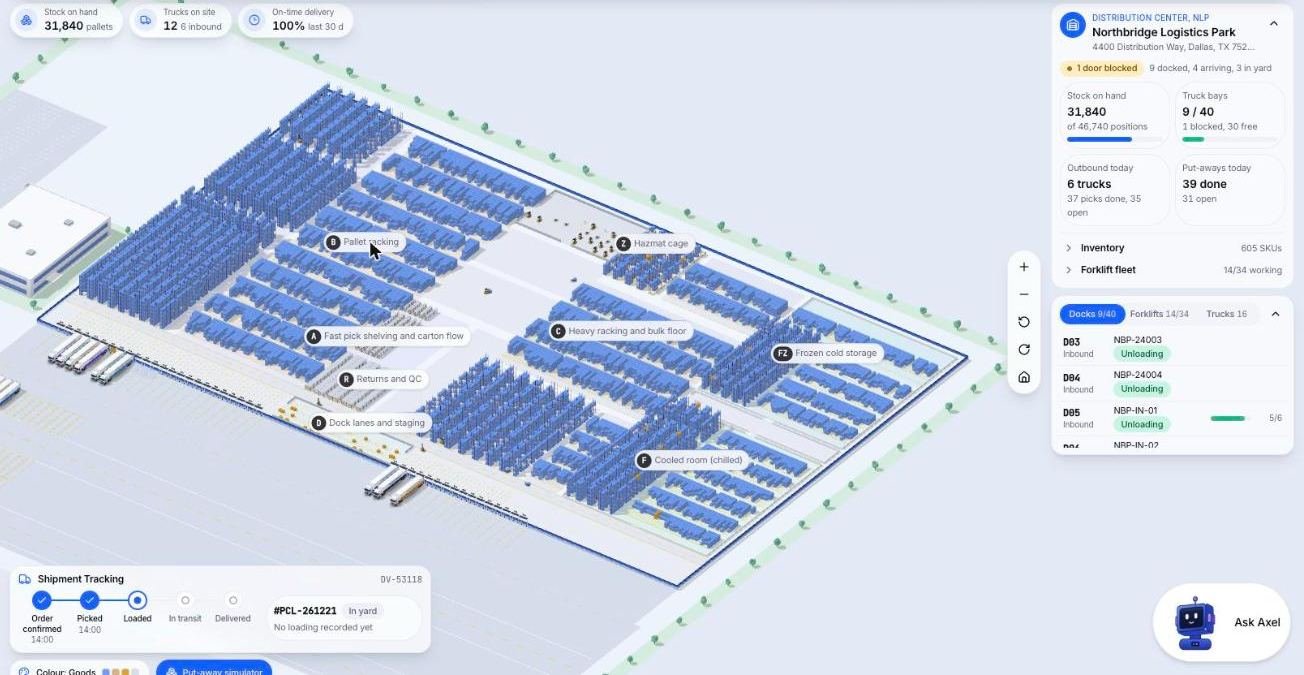
Run the same demo script for all. Give each vendor three of your real scenarios, such as a split receipt, a short pick and a client return. Do not accept a generic tour.
One screen from the Microsive demo platform, demo data, shows the sort of site overview you could ask each vendor to open during that scripted demo.
Keep the cost row honest. Compare totals over the same period. A low monthly fee with high implementation and integration charges can cost more than a higher fee with those included. Make sure every cost bucket has its own line in the reply.
Include a custom build among the options if it fits. It is a legitimate route when your process is unusual. Cargohold, which we make, is a one-time custom build, no per-seat, per-truck or per-client fees. Score every option with the same table.
Write down the decision. One paragraph on why you chose what you chose. Six months in, you will want it.
What an RFP will not do
It will not fix a process you have not understood. If your team disagrees on how returns should work, a new system will not settle it. Sort that out first, then ask vendors to support the answer.
Questions people ask
What is a WMS RFP?
A document you send to several vendors so their answers come back in the same shape.
What should a WMS RFP include?
It has ten sections. They are about you, why you are buying, required capabilities, integrations, implementation and training, support, commercials, data security and exit, references, and response rules.
How long should a WMS RFP be?
Eight to ten pages. A tight document gets better answers than a forty page one that nobody finishes.
How do I score WMS vendor replies?
Score each vendor from 0 to 5 on each criterion after reading the reply and seeing a demo. Set weights that add up to 100 before you open any reply, so the scoring cannot drift toward a favourite.
How many vendors should I send a WMS RFP to?
Three or four. With more than that you will not read the replies carefully.
How do I make WMS vendor demos comparable?
Give every vendor the same three of your real scenarios, such as a split receipt, a short pick and a client return, instead of accepting a generic tour.
Sources
- No third-party facts, prices or vendor claims are used on this page. The template is original working material.